Isaac Newton’s insight was to see that the force of gravity that makes apples fall to Earth also keeps moons and planets in their orbits. Galileo provided the key information that helped Newton understand gravity. Galileo found that falling bodies do not fall at constant rates but are accelerated. The steady increase in the velocity of a falling body by 9.8 m/s2 is called the acceleration of gravity at Earth’s surface. Galileo also discovered that the acceleration does not depend on the weight of the object. Galileo’s description of inertia is a good summary of the principle that became known as Newton’s first law of motion. Galileo published his work on motion in Two New Sciences, in 1638. From the work of Galileo, Kepler, and other early scientists, Newton was able to deduce three laws of motion that describe any moving object:
- A body continues at rest or in uniform motion in a straight line unless acted on by an external force.
- The acceleration of a body is inversely proportional to its mass, directly proportional to the force, and in the same direction as the force.
- To every action, there is an equal and opposite reaction.
With respect to the first law, an object continues to move because it has momentum. An object’s momentum is a measure of its amount of motion, equal to its velocity multiplied by its mass. With respect to the second law, Newton saw that acceleration is the result of force acting on a mass. This law is commonly written as F = ma, where F is force, m is mass, and a is acceleration. Acceleration is a change in velocity, and velocity is speed with a specific direction. The third law states that forces must occur in pairs and in opposite directions. Newton’s three law of motion led him to an understanding of gravity. The first and second laws tell you that falling bodies accelerating downward means there must be some force pulling downward on them. Newton proved that the strength of gravity would decrease as the square of the distance increased (the inverse square law). The third law requires mutual gravitation between bodies and is a general property of the Universe. Every particle with mass in the Universe must attract every other particle, which is why Newtonian gravity is often called universal mutual gravitation. The force of gravity depends on mass. From an analysis of the third law, Newton realized that the mass that resists acceleration in the first law must be identical to the mass causing gravity. From this, combined with the inverse square law, he was able to come up with the formula for the gravitational force between two masses:
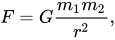
where F is the gravitational force acting between two objects, m1 and m2 are the masses of the objects, r is the distance between the centers of their masses, and G is the gravitational constant. In plain language, Newton’s law of gravitation states: The force of gravitational attraction between two masses, M and m, is proportional to the product of the masses and inversely proportional to the square of the distance between them. Earth’s mass produces a gravitational field through space that is directed toward Earth’s center. The strength of the field decreases according to the inverse square law. Any particle with mass in that field experiences a force that depends on the mass of the particle and the strength of the field at the particle’s location. The force is directed toward the center of the field.
The velocity needed to stay in a circular orbit is called circular velocity. When considering one object orbiting another, it is more accurate to say that the two objects orbit each other, revolving around their common center of mass, which is located near the more massive object. An object in a closed orbit follows an elliptical path. Escape velocity is the velocity required to escape an astronomical body. Angular momentum is the combination of an object’s mass with its speed of rotation or revolution. A planet orbiting the Sun has a specific amount of energy that is the sum of the energy of motion, called kinetic energy, plus energy involved in the gravitational attraction between the planet and the Sun, called potential energy. Every orbiting object is falling toward the center of its orbit but is also moving laterally fast enough to compensate for the inward motion, and it follows a curved orbit.
Tides are produced by small differences in the gravitational force exerted on different parts of an object. The Moon’s gravity is just a bit stronger on the near side of Earth than on the center. It pulls on the oceans on the near side of Earth a bit more strongly than on Earth’s center, and the oceans respond by flowing to make a bulge of water on the side of Earth facing the Moon. There is also a bulge on the side of Earth faces away from the Moon because the Moon pulls more strongly on Earth’s center than on its far side. Thus, on the far side of Earth the Moon pulls Earth away from the oceans, which flow into a second bulge, this one pointing away from the Moon. The ocean tides are caused by the accelerations Earth and its oceans feel as they orbit around the Earth-Moon center of mass. The tide does not really “come in”; it’s more accurate to say you move into the tidal bulge. The tides rise and fall twice a day on a normal coastline because there are two bulges on opposite sides of Earth. The tidal cycle at any given location is affected by the latitude of the site, shape of the shoreline, wind strength, and so on. The Sun also produces tides on Earth, which are less than half as high as those caused by the Moon. At new moon and full moon, the Moon and Sun produce tidal bulges that add together; such tides are called spring tides. At first and third quarter moons, the Sun and Moon pull at right angles to each other, and the tides caused by the Sun partly cancel out the tides caused by the Moon; these are called neap tides. Friction from tides can slow the rotation of a rotating object, and the gravitational pull of tidal bulges can make orbits change slowly.
Newton’s laws were foundations of astronomy and physics for two centuries. Albert Einstein’s theories did not replace Newton’s laws but rather showed that they were only approximately correct and could be seriously in error under certain special circumstances. Einstein’s first postulate of relativity (the relativity principle) states that the laws of physics are the same for all observers, no matter what their motion, so long as they are not accelerated. Einstein’s second postulate of relativity states that the speed of light in a vacuum is constant and will have the same value for all observers independent of their motion relative to the light source. Newton’s laws of motions and gravity work well where distances are small and velocities are low but are not adequate for large distances or high velocities. The observed mass of a moving particle depends on its velocity. The energy of a motionless particle is not zero (E = m0c2). The first two postulates are part of Einstein’s special theory of relativity. Einstein’s general theory of relativity contained a new description of gravity. The equivalence principle states that observers cannot distinguish locally between inertial forces due to acceleration versus uniform gravitational forces due to the presence of a massive body. General relativity explains gravity as mass telling space-time how to curve and curved space-time telling mass how to accelerate. General relativity also predicts that a rapid change in a gravitational field should spread outward at the speed of light as a ripple in space-time labeled gravitational radiation.
—February 2023
 Lance Jones